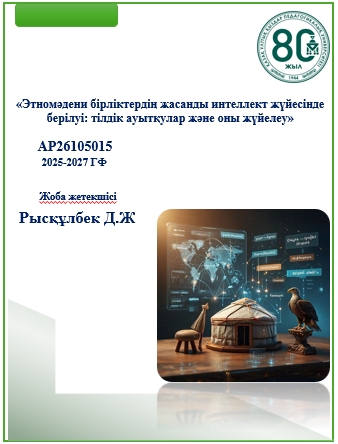
Riskulbekov D.ZH
-
-
![]()
-
Project Title: Transferring Ethnocultural Units to Artificial Intelligence Systems: Linguistic Variations and Their Systematization
The goal of the project is to identify and systematize ethnocultural units (phraseologisms, linguaculturalisms, lexical and paroemiological units, metaphors) that cause difficulties in machine translation and interpretation. This will help improve the quality of information transmitted through artificial intelligence systems, such as chatbots and machine translation systems, and reduce linguistic deviations. The goal of this work is to create a translation dictionary that translates units of ethnocultural significance in the Kazakh language into Russian and English, supplement the theoretical framework of errotology based on specific linguistic data, and develop equivalents of ethnocultural units in three languages (Kazakh, Russian, and English).
Expected Results: The project's results can be widely used in scientific research, education, and economics. The project paves the way for interdisciplinary research in linguistics, ethnography, cultural studies, and artificial intelligence. Successful implementation of the project will have a positive impact on the methods of teaching Kazakh as a native and foreign language. Students of the Kazakh language will be able to master it more easily by knowing the literal translation of complex ethnocultural units in vocabulary and their use in context. High-quality translations of ethnocultural units will facilitate the adaptation of various brands to local markets, the optimal use of marketing strategies, and the strengthening of intercultural communication. This will also contribute to the international recognition and promotion of the material, spiritual values, and cultural heritage of the Kazakh people. The use of artificial intelligence technologies in the processing and analysis of linguistic deviations will expand Kazakhstan's capabilities in the field of technological solutions. The project's results can be used to improve the competitiveness of the Kazakh language in the information space. These can be used to create programs and models for translating information data and literary, musical, and cinematic works in Kazakh into foreign languages, as well as foreign works into Kazakh, taking into account the nature of the language and ethnocultural characteristics. Most importantly, the creation of a dictionary-translator of ethnocultural units into Russian and English, the addition of a theoretical framework for errotology based on specific linguistic data, and the development of equivalents for ethnocultural units in three languages (Kazakh, Russian, and English) will positively impact the expansion of the linguistic potential and scope of the Kazakh language. Understanding the correct use of ethnocultural units and their specific linguistic equivalents will help resolve social issues related to language use and improve the functioning of the Kazakh language as an official language. The electronic dictionary, metadata, articles, and other materials developed within the project will become a professional tool for linguists and translators, will contribute to the development and improvement of reading and writing skills among Kazakh speakers in general, and will also serve as a basis for linguistic and ecological research.
-